Case Study 05 — Editorial Workflow
KY Follow-Up Desk
A working prototype that scrapes the station's RSS feed nightly, queues today's local stories for review, and writes tagged follow-ups directly to a shared Google Calendar — so the stories worth revisiting don't disappear into the rundown.
Prototype
Most follow-up stories don't get assigned because nobody remembers to assign them.
The original story runs. The deadline passes. The next thing fills the rundown. A federal grant with a six-month review window, a criminal case still working through the courts, a farmer you talked to about fertilizer prices — these stories don't disappear. They go invisible.
A lot of reporters are not naturally good at reconnecting with past subjects. That's not a criticism — it's a structural problem. The newsroom rewards the next story, not the follow-up on the last one. This system is built around that reality.
Every night, an automated capture agent pulls the Spectrum News Kentucky RSS feed, filters for stories by local reporters, deduplicates against the existing queue, and sends a summary email. No manual input required.
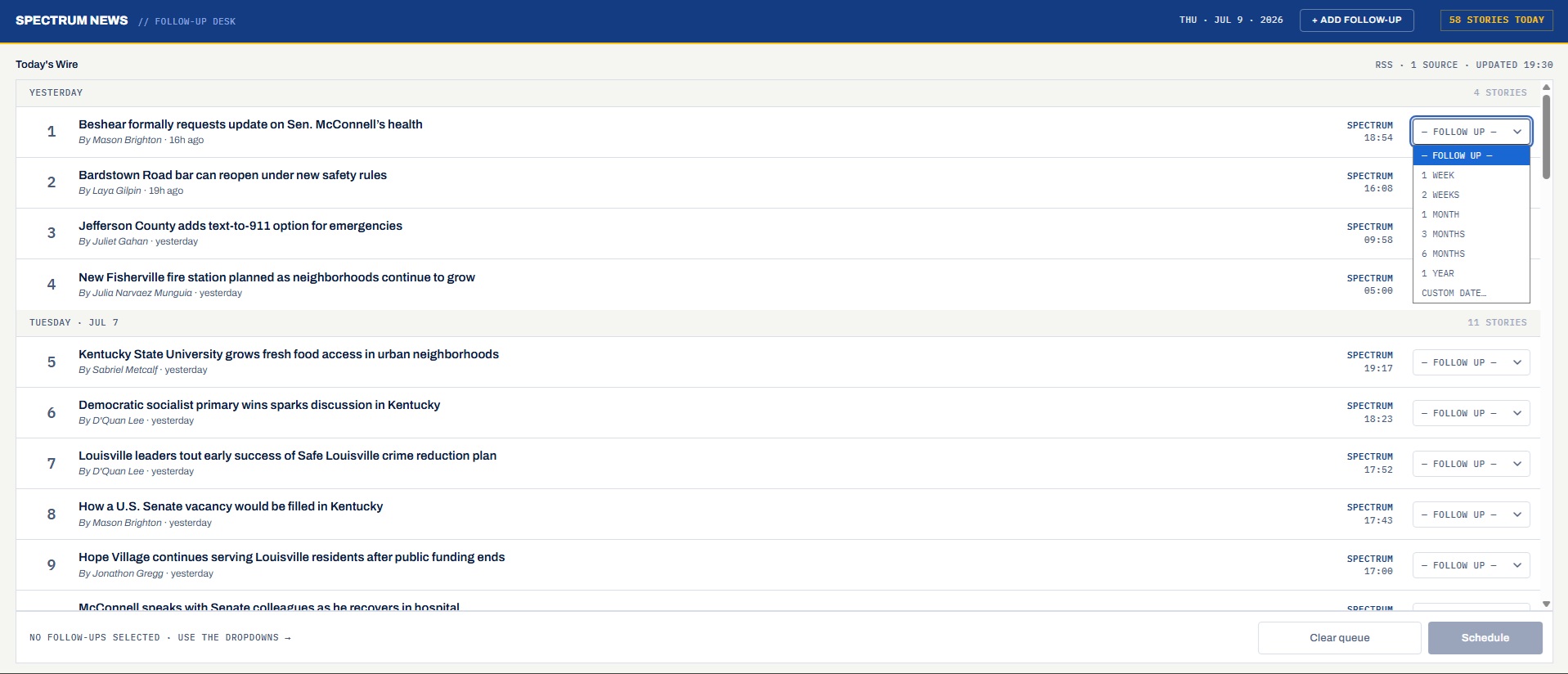
Each morning, the tagger web app opens to a numbered list of queued stories grouped by date. Select a follow-up interval from the dropdown — or leave it blank to skip. One submit schedules everything at once.
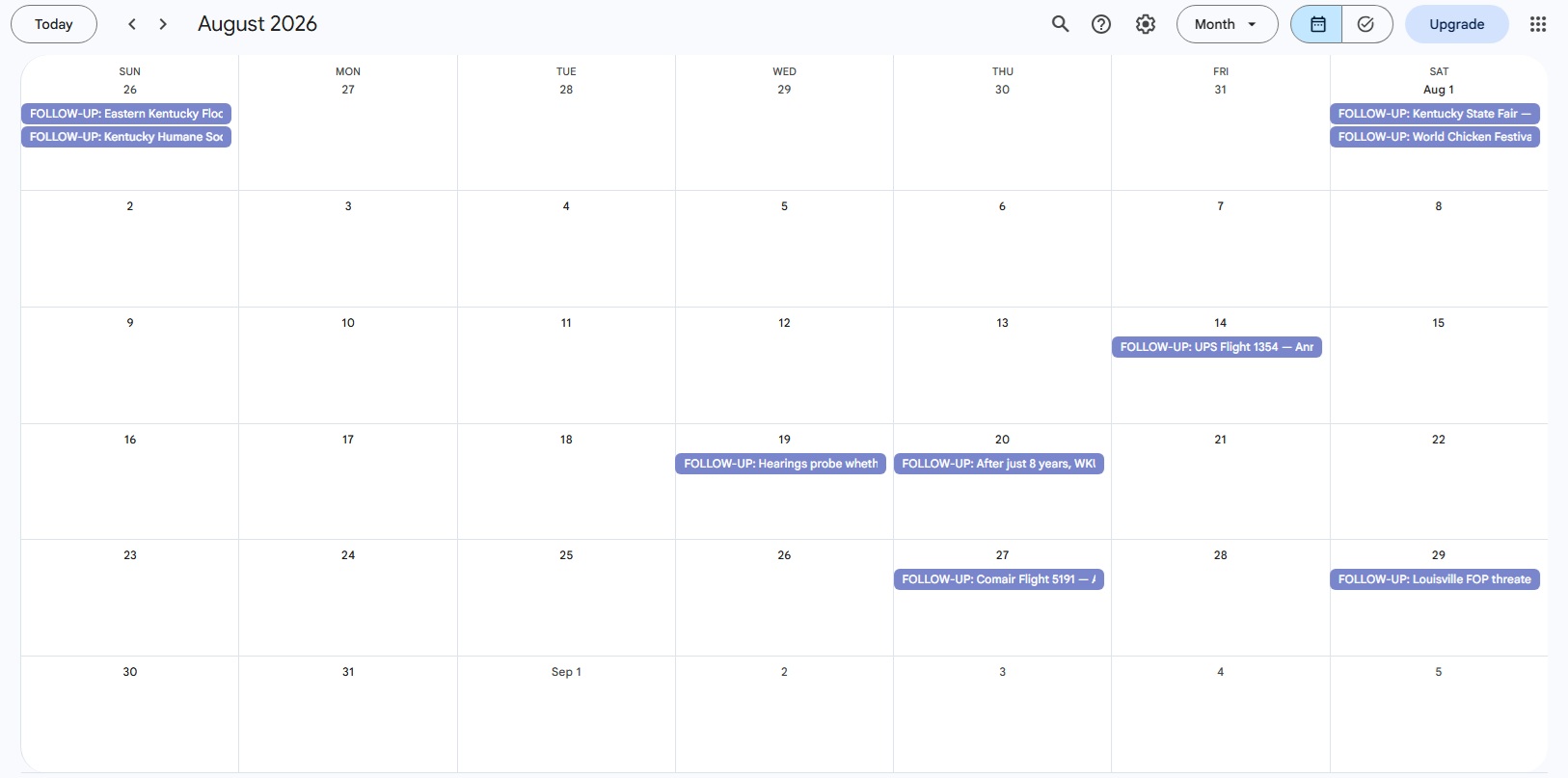
On submit, each tagged story lands on a shared Google Calendar as a full-day event with the headline, reporter byline, original URL, and capture date attached. Anything untagged clears automatically.
On the first Monday of each month, a digest email arrives with everything landing that month — so conversations with reporters can start early. "Hey, remember that farmer we talked to about fertilizer prices six months ago? Let's circle back."
Beyond the daily wire, the calendar is pre-populated with annual milestones — Breonna Taylor, the Carrollton bus crash, the Eastern Kentucky floods, major natural disasters, mass shooting anniversaries. Stories that demand coverage every year. This allows for more planning into stories that demand coverage every year.
The system also accepts manual entries for stories sourced outside the RSS feed, making it a single source of truth for planned follow-up journalism, not just reactive capture.
"The assignment desk has always been about knowing what to chase next. This is one idea of what that looks like when you give it the power of AI."
- Default is no follow-up. Submitting a blank form clears the queue. The system is designed for selectivity, not volume.
- Follow-up intervals are preset but flexible. Six standard intervals — one week through one year — cover most cases with a single click. A date picker is also available for stories that need a specific date outside the presets.
- Capture date drives the math. A story captured Monday and tagged Friday with "2 weeks" resolves to two weeks from Monday — not Friday. The follow-up reflects when the story was reported, not when it was reviewed.
- The queue persists until you clear it. Untagged stories stay in the queue across weekends, time off, and sick days. This is by design — the desk doesn't punish you for being away. Stories wait until you're ready to review them.
| Component | Technology |
|---|---|
| Platform | MindStudio |
| Capture | Nightly cron · RSS fetch · Claude Haiku filter |
| Tagger | MindStudio web app · Published URL |
| Calendar | Google Calendar API · OAuth · Shared calendar |
| Digests | Weekly + monthly email · Automated |
This is a working prototype — built, deployed, and in active personal use. It has not been formally adopted by the newsroom. The infrastructure is live. The calendar is filling. The test period is ongoing.